Στήλες HPLC & UHPLC

Ion Exchange Chromatography (IEC)

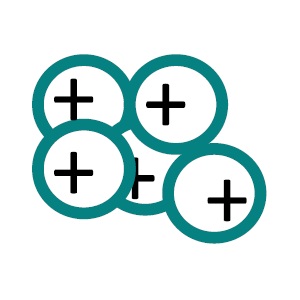
Ion Exchange Chromatography (IEC) is a technique based on the difference in the strength of the interaction between a sample ion and an oppositely charged functional group on the support. The sample ion competes for the functional group with a counter ion that has been added to the mobile phase as a salt. Elution is most often accomplished by increasing the salt concentration over time.

Ion Exchange Chromatography (IEC) is a technique based on the difference in the strength of the interaction between a sample ion and an oppositely charged functional group on the support. The sample ion competes for the functional group with a counter ion that has been added to the mobile phase as a salt. Elution is most often accomplished by increasing the salt concentration over time.

Ion exchange chromatography is the most common separation mode for protein purification schemes. Biomolecules generally have charged groups on their surfaces, which change with the pH of the solution.

Anion Exchange Chromatography is performed with either a strong anion exchange column, containing a quaternary ammonium ion, or with a weak anion exchanger, having either a tertiary or secondary amine functional group, such as DEAE (diethylaminoethyl). A counter ion, often Cl-, maintains electroneutrality.

Cation Exchange Chromatography is performed with either a strong cation exchanger, containing a bonded sulfonic acid group, such as sulfopropyl (SP), or with a weak cation exchanger, containing a weak acid such as carboxymethyl (CM). A counter ion, often Na+, maintains electroneutrality. The advantage of strong vs. weak ion exchangers is that the first are charged over a wider pH range. Weak ion exchangers often provide slightly different selectivity from strong exchangers.

In ion exchange chromatography, the pH of the mobile phase buffer must be between the pI or pKa of the charged molecule and the pKa of the charged groups on the solid support. For example, a molecule with a pI of 8.2 is run in a mobile phase buffer at pH 6.0 with the solid support pKa at 1.2 in cation exchange chromatography. In anion exchange chromatography a molecule with a pI of 6.8 is run in a mobile phase buffer at pH 8.0 with the solid support pKa at 10.3.

Size Exclusion Chromatography (SEC)

Size Exclusion Chromatography (SEC) separates molecules based on their size, or more precisely, their hydrodynamic volume. It is based on the discrimination of individual sample components by the pores of the packing material. Large sample molecules cannot or can only partially penetrate the pores and elute from the column first, whereas smaller molecules can access all or a larger number of pores and elute later. SEC is the only mode of chromatography that does not involve interaction with a stationary phase by means of adsorption or partitioning of the solutes.

Size Exclusion Chromatography (SEC) separates molecules based on their size, or more precisely, their hydrodynamic volume. It is based on the discrimination of individual sample components by the pores of the packing material. Large sample molecules cannot or can only partially penetrate the pores and elute from the column first, whereas smaller molecules can access all or a larger number of pores and elute later. SEC is the only mode of chromatography that does not involve interaction with a stationary phase by means of adsorption or partitioning of the solutes.

The terms SEC, GFC (gel filtration chromatography) and GPC (gel permeation chromatography) all refer to the same chromatographic technique. In GFC an aqueous mobile phase is used, while an organic mobile phase is employed in GPC. The general term SEC covers both uses.

SEC is the dominant mode of separation for natural and synthetic polymers:
GFC is the term used for the size-based separation of water-soluble polymers, for example biopolymers or natural polymers.
GPC is the term used for the size-based separation of polymers soluble in organic solvents.

Size exclusion chromatography columns are traditionally packed with porous polystyrene divinylbenzene (PS-DVB) or silica particles. PS-DVB columns are commonly used for the analysis of synthetic polymers in organic solvents, while silica-based columns are used for the separation of biopolymers.

Avantor® Hichrom other columns

Eprogen, Exsil, Avantor® Hichrom C8, C18 and RPB, Avantor® Hichrom PAH2, Avantor® Hichrom Chiral, Inertsil, LiChrosorb, LiChrospher, NUCLEOSIL, Avantor® Ultrasphere, ZORBAX

Eprogen, Exsil, Avantor® Hichrom C8, C18 and RPB, Avantor® Hichrom PAH2, Avantor® Hichrom Chiral, Inertsil, LiChrosorb, LiChrospher, NUCLEOSIL, Avantor® Ultrasphere, ZORBAX

HPLC columns, Avantor® Partisil® & Partisphere®

Commercially available spherical silicas and it continues to provide and reproducible, high efficiency separations, Avantor® Partisphere® columns are available in a wide range of surface chemistries including two application specific phases.

Commercially available spherical silicas and it continues to provide and reproducible, high efficiency separations, Avantor® Partisphere® columns are available in a wide range of surface chemistries including two application specific phases.

Need a column to separate carbohydrates using dilute acid mobile phase? These polymeric ligand exchange columns utilize a range of counter ions to deliver selectivity required.

Are your analytes ionizable or charged in solution? Our silica-based ion exchange columns are ideal for smaller water-soluble compounds.

Want to separate ionic and hydrophobic analytes in a single run? The multi-functionality of these columns can eliminate column switching, ion paring, or using columns in series.

Need a HILIC column for very polar analytes? These columns are well suited for separating hydrophilic molecules, including carbohydrates, glycans, and peptides.

Have difficulty retaining polar hydrophilic compounds by RP chromatography? These columns strongly retain compounds that are unretained by conventional reversed phase, without the need for ion-pair additives.

Is your sample insoluble in mixtures of water and organic solvent? We manufacture a range of bonded and non-bonded normal phase columns that are ideal for the retention and separation of lipophilic compounds.

Need to maximize your productivity and flexibility in method development? We offer an array of RP chemistries to optimize separations and provide enhanced retention or changes in elution order.

Have a biological sample? Get high resolution, high efficiency separations from our unique chemistries that are specially designed for proteins, peptides, carbohydrates, nucleic acids, oligonucleotides and more.