Trajan-SGE

Trajan (former SGE Analytical Science) has long been a manufacturer of GC capillary columns with the complete technology capability to produce the finest capillary columns from beginning to end, including the special requirements of producing the fused silica capillary tubing.
This end-to-end manufacturing capability allows Trajan to control the fabrication process precisely to produce the finest quality capillary columns available.
The individual technologies Trajan employs in GC capillary column manufacture are:
Drawing of the precision fused silica capillary tubing.
Developing and synthesizing the specialty polymer stationary phases.
Performing the specialty chemical treatment of the fused silica surface so that it is inert and compatible for the cross-linked stationary phase.
Coating and cross-linking the polymer stationary phase.
Quality testing of every completed capillary column to rigorous standards.


Trajan (SGE) GC Capillary Column Phases

Polyethylene Glycol

BP21, BP20, SolGel-WAX™ (PEG) ‘wax’ type phases where the main separation mechanisms are hydrogen bonding or dipole interactions. The wax phases are often considered as ideal for mixtures of chemically different components such as those contained in essential oils.

BP21, BP20, SolGel-WAX™

(PEG) ‘wax’ type phases where the main separation mechanisms are hydrogen bonding or dipole interactions.

The wax phases are often considered as ideal for mixtures of chemically different components such as those contained in essential oils.

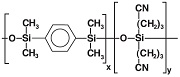
Cyanopropyl Polysilphenylene Siloxane

BPX70, BPX90 High cyanopropyl substituted phases, are more difficult to make as efficient, thermally stable phases. BPX70 is equivalent to and behaves like a 70% cyanopropyl siloxane but with siphenyl end substituted backbone for stability which was introduced in 1987 and remained the most polar thermally stable phase for a long time. BPX90 which is equivalent to a 90% cyanopropyl siloxane and stable to 300 °C which is excellent for such a polar phase. The prominent interaction for BPX90 is π – π bonding with the cyano group; the cyano groups become almost entirely responsible for the partitioning.

BPX70, BPX90

High cyanopropyl substituted phases, are more difficult to make as efficient, thermally stable phases.

BPX70 is equivalent to and behaves like a 70% cyanopropyl siloxane but with siphenyl end substituted backbone for stability which was introduced in 1987 and remained the most polar thermally stable phase for a long time.

BPX90 which is equivalent to a 90% cyanopropyl siloxane and stable to 300 °C which is excellent for such a polar phase. The prominent interaction for BPX90 is π – π bonding with the cyano group; the cyano groups become almost entirely responsible for the partitioning.

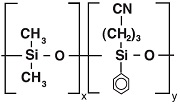
Cyanopropylphenyl Siloxane

BP225, BP10, BP624, BPX-Volatiles ‘Polar’ phases with <50% cyanopropyl substituted dimethylpolysiloxane.

BP225, BP10, BP624, BPX-Volatiles

‘Polar’ phases with <50% cyanopropyl substituted dimethylpolysiloxane.

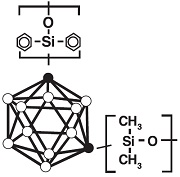
Polycarborane Siloxane

HT5, HT8 The carborane phases were originally developed as very high thermal stability phases for high temperature work to 460 °C. The functionality of the carboranes is diffi cult to explain – they end up with pentavalent bonds with shared sigma bonds rather than π – bonds. The bonds are transient like a benzene with a ball of shared electrons. HT5 and HT8 are low π – bonding purely due to the low concentration of carborane in the polymer, otherwise it would be high.

HT5, HT8

The carborane phases were originally developed as very high thermal stability phases for high temperature work to 460 °C. The functionality of the carboranes is diffi cult to explain – they end up with pentavalent bonds with shared sigma bonds rather than π – bonds. The bonds are transient like a benzene with a ball of shared electrons.

HT5 and HT8 are low π – bonding purely due to the low concentration of carborane in the polymer, otherwise it would be high.