
Polyethylene Glycol

BP21, BP20, SolGel-WAX™
(PEG) ‘wax’ type phases where the main separation mechanisms are hydrogen bonding or dipole interactions.
The wax phases are often considered as ideal for mixtures of chemically different components such as those contained in essential oils.
Cyanopropyl Polysilphenylene Siloxane
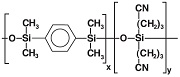
BPX70, BPX90
High cyanopropyl substituted phases, are more difficult to make as efficient, thermally stable phases.
BPX70 is equivalent to and behaves like a 70% cyanopropyl siloxane but with siphenyl end substituted backbone for stability which was introduced in 1987 and remained the most polar thermally stable phase for a long time.
BPX90 which is equivalent to a 90% cyanopropyl siloxane and stable to 300 °C which is excellent for such a polar phase. The prominent interaction for BPX90 is π – π bonding with the cyano group; the cyano groups become almost entirely responsible for the partitioning.
Cyanopropylphenyl Siloxane
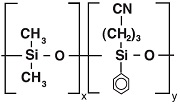
BP225, BP10, BP624, BPX-Volatiles
‘Polar’ phases with <50% cyanopropyl substituted dimethylpolysiloxane.
Polycarborane Siloxane
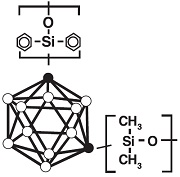
HT5, HT8
The carborane phases were originally developed as very high thermal stability phases for high temperature work to 460 °C. The functionality of the carboranes is diffi cult to explain – they end up with pentavalent bonds with shared sigma bonds rather than π – bonds. The bonds are transient like a benzene with a ball of shared electrons.
HT5 and HT8 are low π – bonding purely due to the low concentration of carborane in the polymer, otherwise it would be high.
Phenyl Polysilphenylene Siloxane (Silphenylene substituted Polydimethylsiloxane)
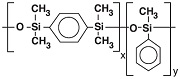
BPX5, BPX35, BPX608, BPX50
Silphenylene phases have become fairly common now with many manufacturers offering at least some phases of this type, SGE has a full range.
Phases with the “X” notation have a silphenylene backbone (exception is the BPX1). Phenyl substituted polymers are relatively non-polar and rely for their different functionality on π – bonding with the aromatic phenyl groups.
SGE was the first GC capillary column manufacturer to introduce this type of phase commercially in the 1980s with the intention of improving the thermal stability to give higher maximum temperatures and reduced bleed.
Diphenyl Dimentyl Siloxane (Phenyl substituted Siloxanes)
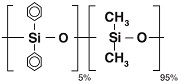
BP5
The classical 5% phenyl group of phases
Polysiloxane
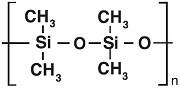
BP1, BP1 PONA, BPX1, SolGel-1ms
Polydimethylsiloxane (PDMS) “non-polar” type phases which rely on Van der Waals interactions between molecules and separate primarily based on “boiling point” type separation.
Useful chromatographic space is usually considered in terms of modifications to non-polar retention. This is understandable because the GC is useful for volatile compounds and that usually means organics. Organics that can be vaporized are generally high in non-polar (alkane or hydrocarbon) character. It is this part of their surface that allows them to be soluble in a non-polar phase. It is also this characteristic that makes the BP1 (dimethylsiloxane) a universal phase.
Industrial

We have been supplying the industrial sector with premium quality reference materials and proficiency testing schemes for more than 35 years.
Forensic and Toxicology

Whichever drug or metabolite you are analysing, we can provide the reference materials for all your clinical, forensic and sports testing needs.
We have solutions, powders and matrix materials, with analytes and at concentrations appropriate for you and your laboratory workflow. To help you source just the reference material you need, we bring together a unique and comprehensive range of standards for prescription drugs, drugs of abuse, new psychoactive substances (NPS), steroids/sports drugs, antibiotics, stable isotope labelled drugs, drug metabolites, alcohol standards, derivatizing reagents and phytochemicals.
Environmental

As a leading global provider of reference materials, we aim to support your environmental analytical testing to help ensure your results are reliable and fit for purpose. Our ever-evolving portfolio continues to expand and adapt to changing requirements and technology, with a portfolio of products devoted to crucial global regulations, alongside leading ranges of pesticide, aqueous inorganic and stable isotope labelled reference materials.
Food and Beverage

Since 1975, we have led the way in providing pesticide reference standards. Today, our portfolio has expanded to adapt to changing regulations and technology, to support your need for high quality reference materials for your food, beverage and cannabis testing. Our portfolio stands apart from the crowd in its commitment to quality, producing to the highest standard and providing expert analytical support and documentation, so that you know you are receiving products you can trust.
Pharmaceutical
For decades we have supported the pharmaceutical community with more than 10,000 high-quality reference standards for pharmaceutical quality control from sources all over the world. Our quality enables your accuracy, helping you to create ever better, safer medicines: products in our Mikromol range of more than 5,000 pharmaceutical API, impurity and excipient reference standards each come with a comprehensive Certificate of Analysis detailing the material’s characterization process, ensuring its suitability for both qualitative and quantitative analysis. Our dedicated analytical, synthesis and customer service teams go beyond the standard, and our depth of knowledge, decades of manufacturing experience and scientific excellence ensure your peace of mind.